Creative Blocks: Comparing Yourself to Others - Finding Inspiration in Yourself


Do you sometimes find yourself wishing you could draw, paint or create like someone you admire - so much so, that you feel that your work will never be as good? Or worse yet, you concluded that you have no talent, so why bother?

Finding inspiration in the work of fellow creatives can further develop your creativity and personal style, but it can also stifle or create blocks if you place another's skills and talents above your own.

While it may be true that someone else may have highly developed skills and talent with years and years of experience, placing yourself in comparison with them puts you at an unfair disadvantage.  And the inner critic will seize on this opportunity to start planting those pesky seeds of doubt.

The thing is, if you had that person's life experience and talents and followed their same path, you might even be better - or - you might still have the same doubts.

I believe that everyone is or has the ability to become more creative.  It is part of your being that has been with you from the beginning.  Sometimes though, creativity may not have been valued and was discouraged at an early age, or wasn't recognized and given the opportunity to flourish or there may not have been any exposure to the creative arts.  But I tell you, there is creativity in every soul - it just needs to be cultivated and allowed to follow its own path whether it be in a studio, kitchen, lab or wherever!

Seeing your creativity develop and blossom as a long, exciting journey taking you to unexpected places and meeting interesting people is the key to disconnecting from those unfair comparisons.

Remember this:  Everyone is at a different point on their journey with different skills and talents.  They also have unique backgrounds and stories to tell with destinations that are unknown to you.  Their art tells their story.  It is their perspective, and it is authentic to who they are.  It is the expression of their soul.

Finding how to express your voice - what is distinctly you, is what will truly bring joy into your life.  That is what the creative journey is all about - finding how to express what is within you and following the voice that will take you further on the journey.

If you try to work in the style of someone you admire, do it for the experience of exploration and experimentation, but add your own twist to it.  If you try to make it your style, you'll never be truly satisfied.  It will always look like that person who is dressed up in a style that is totally out of character for them. 

If, what you create, is a reflection of who you are, you will better appreciate and become inspired by the work of others rather than compare your work to theirs.

Find ways to inspire yourself.  Be willing to experiment with different materials and techniques.  Find the tools and materials that feel the most comfortable and expressive to you.  Sometimes, switching to a different medium or tool is the key to unleashing your creativity.

Approach your experimentation and journey with a sense of adventure and fun.  Find the joy in the process, not the end product.  The more you are willing to explore, the further along you will be in your journey.  And the more you do, the more you will see your personal style evolve.  It's like learning a new language.  With practice, you will become fluent.
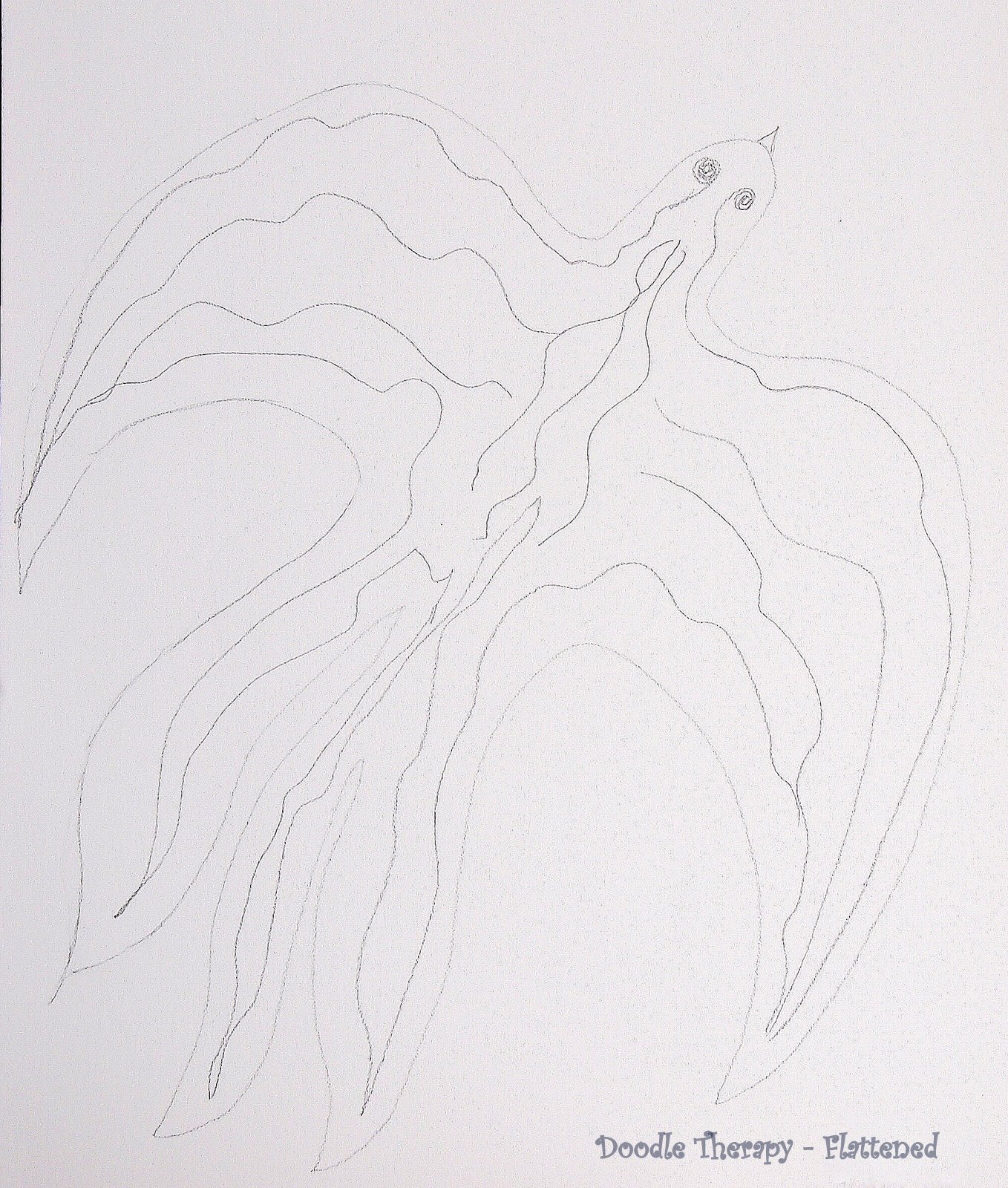
Flattened - Journal entry done when energy was very low


The Daily Doodle Journal is an easy way to document your progress.  The Daily Doodle Journal is different in its approach to visual journaling in that the focus is on a mind-body connection to bring out what is within.  Simple doodles and quick drawings like the one on the right, emerge from what one if feeling at the moment.  Intuition guides your hand.  Creative impulses are given total freedom.  The emphasis is not on a completed work of art, but the emerging personal symbols and style.  It is an outlet for releasing negative energy and seeing what it looks like on paper. 


In short, it is a visual documentary on the evolution of your creative spirit!

Use the Daily Doodle Journal as a separate journal if you already have or prefer an art journal.  It will give you the space to do "creative warm ups" and clear out any negative energy that might be holding you back.

Keep the Daily Doodle Journal for doodles or scribbles when trying to come up with a new idea or trying to get through some creative block or problem. 

Words can be added, but I think you will find that the images will reveal far more and will speak to you at a much deeper level.  Referencing back to them at another time can reveal even more.

Another way to help develop your style and discover your personal symbols, is the exercise I described in Drawing to Music.  If you play music you absolutely love, that actually makes you want to move to the music, you will find that your style will be much easier to access.  Interestingly, you may also find that your creative style probably has some type of visual connection to the type of music you enjoy.

Click here - Daily Doodle Journal - for more info on how to set up yours.

How do you inspire yourself and develop your creativity?  Please feel free to leave a comment about what works for you.  I'd also love to know if you started a Doodle Journal.

Happy Doodling!

Visual Journaling - Transforming Negative Energy With Reframing


The highly expressive art of visual journaling is one of the most effective practices/therapies for personal growth and self-reflection.  The power of art and doodling to inspire healing and transformation has been a well known secret that has finally gone mainstream with the now readily available products, books, blogs and magazines. 

Just the recording and capturing of your feelings and personal journey in a journal is therapeutic.  But if you are using your visual journal to work through issues or to relieve stress, the process can be transformational.

One technique that you may want to incorporate into your visual journaling practice is reframing.  Reframing is the ability to take a thought, idea or emotion and flip it to see it from a different or opposite perspective.  Adding reframing to your journaling adds the element of resolution, which may be appropriate for your journal.  If it doesn't fit with the style of your journaling, but you like the idea of reframing, you may want to consider a separate journal for problem solving.

To use reframing in your journaling, you would use it as a 3-step process.
  • First, create your page or an image expressing something that is causing stress, negative energy or pain.
  • After taking some time to take in and reflect on what you created and the feelings it brings up, try to envision the image in another light.
  • Allow your feelings and energy to guide you.  Don't think it; feel it!  If you feel the urge to draw or paint something totally foreign in style to you, fight the urge to ignore it - put it on paper!
  • If what you are feeling is very intense, you may need to do a few additional pages, allowing the intensity to dissipate naturally in stages.
  • Many techniques can be used to reframe or replace an image, but most importantly, it will work best if it is a natural progression, rather than forced. 
  • Sometimes, just a change in color selection can transform the look and feel.  If you used bold or dark colors, try using something softer or brighter for your reframed image.  If the colors were intense and warm, try cooling off the look with soothing cool tones.
  • You can use the same elements and shapes in a different setting or background or use something that is a similar shape for reframing.
For example, I did a drawing of a mushroom cloud and scorched earth, which in itself, deflated much of the toxic energy that I was feeling.  When some of that energy dissipated, the image that came to me was a tree, which I drew in a similar shape to the mushroom cloud.  That image and the process of drawing it helped shift my energy to a more positive state. 

Doodle Therapy - Criticism - Patricia Kay

In the example above, I was dealing with my "old friend", criticism.  I say old friend, because it has been in my life so long and doesn't seem to be ready to leave any time soon.  So, I decided to reframe it and just consider it an annoying friend that takes aim at me, but can't penetrate my new protective force field show below.


Doodle Therapy - Energy Force Field - Patricia Kay

Use the style of visual journaling that you prefer.  Reframing works well whether you use a raw style, simple doodles or a mixed media layered technique.  For myself, I like to use quick doodles done in pencil that resemble my energy state at the moment and continue drawing additional pages until I feel a shift in energy to a more positive state.

If I am feeling or experiencing something more disruptive that I need to work through, I will do something more detailed and in color.  I also make these images more simplistic or child-like to better express the emotion.

While I love the bold, more complex, layered techniques and using journaling in the image, I prefer to write on the opposite page of my journal - it's just my personal preference.  I find that for me, the more involved and detailed the image, the more involved I become in the completed project instead of the process of dealing with the feeling.  Simple, quick drawings help me maintain my focus.  I also like to refer back to my pages and would rather "feel" what the image has to convey to me in my current state of mind without the influence of the words.

I recommend though, that whatever approach to take, that you follow your heart and do these exercises in a style that is in your own voice.  Only then will it ring true and put you on the path to personal growth and transformation.

If you're like me and love to immerse yourself in the inspiration of beautiful art from kindred spirits, the following books will take you on a journey to explore and further develop your technique and creativity.  And for more information on starting your Daily Doodle Journal, click this link.

Happy Doodling! 

Scrapbookers: Take Your Creativity to A New Level

  
Doodle Therapy - Pink Sorbet - Patricia Kay

There are thousands of beautiful background pages for scrapbooking.  But, if you're a seasoned pro or looking for a new approach, why not create your own?

Sometimes you have a special page that needs a unique and special background that you just can't find.  If you follow some of the techniques that I outlined in Meditative Painting and Recycled Art, you will end up with a collection of your own original art to use for your backgrounds and embellishments.

I love to paint layered background-type paintings as a stress reliever and meditative practice.  Some I leave untouched and others I use for paper mosaics or other art projects.

For this post, I'll focus on three ways to use your meditative paintings to create your own original art.

The example above was created by using a simple painting technique with acrylic paint on smooth Bristol paper.  See Meditative Painting for more information on what you will need, the how-to's and painting style choices. 

Doodle Therapy - Blue Energy - Patricia Kay

The paints were thinned with water to create a transparent watercolor-like glaze.  A basic horizontal brushstroke from edge to edge was used, letting it fade and intensify sporadically.  Alternating orange and raspberry, layer after layer, blended the colors.  Multiple layers can be used until the desired effect is achieved.

Or you can try something like the example to the right, using a fan brush with a swirling brushstroke.

Don't worry if it doesn't come out exactly as you expected.  To me, imperfections are perfect as they are.  But, if you are not satisfied with the results, you can use the mosaic method, which gives you the option of cutting away the offending flaw.

If you are satisfied, you now have a page that is ready to use without cutting it into paper mosaic tiles.  If you used a paper smaller than 12x12, you can mount it on a coordinating, solid color sheet of your choice. 

For the paper mosaic technique, cut the painted paper into various strips, squares or punched shapes.  In the example at the top of the page, the painting was cut into 1 inch squares, along with 1 inch and 3/4 inch circles, glued onto Bristol vellum.  It was then mounted on a coordinating color.  You can use it as is, but if you want to cut down on the thickness and weight of the page, photograph it and have it printed.

To make this design more ideal for a scrapbook page, I would add squares to cover a larger area or use the squares for smaller design areas to create different sections or elements on the page.  This example is just to give you an idea of how to create a mosaic pattern from your painting.

You can also cut larger sections to create panels, borders or accent elements. 

In the example below, the same design used at the top, was photographed and cropped to create yet another version of the original painting.  Using the camera's software, it was given a cool tint and the contrast was then softened to to give it a lighter quality. 

Once you have finished altering your photograph of your painting, you may want to have this printed at a copy store to ensure that the ink doesn't fade or smudge.  Just ask for acid free paper.


Doodle Therapy - Pink Sorbet Tic Tac Toe - Patricia Kay

For the page further below, have fun dabbing paint with various sized fluffy, round brushes to create a page full of circles and dots.  By using thinned paints as glazes, a more luminous look can be achieved.  You can create bold and bright or light and airy designs that reflect your mood and personality - all in a simplified technique.

Try your hand at creating your own background papers for photos that need something unique or customized.


When you're ready to start, take yourself back to the time and place where you were when the shot was taken.  Bring back those memories and feelings and then select your colors that express those memories.

Recreate those feelings in your brushstrokes - just follow your creative impulses.  Dab, streak or swirl the paint in whatever feels right.  If it doesn't come out exactly as expected, keep it for another day.  You'll find that anything you create in this way will be just the perfect choice for what you will need somewhere down the road.

On the other hand, if you can envision it potential and beauty cut and designed into a beautiful mosaic piece, you will see that it is exactly as you intened it to be.  
  
Doodle Therapy - Puffs - Patricia Kay

Continue creating your own original art for your scrapbook pages so you have a collection to choose from.  Your pages will truly stand out as uniquely and distinctly you.

Looking for more inspiration?  Try painting your pages to music.  See my post on Drawing to Music.  And don't forget to keep up or start your Daily Doodle Journal to keep those creative ideas flowing.

Happy Doodling!

Creative Stress Relief - Meditative Painting

Doodle Therapy - Blueness - Patricia Kay


Looking for a creative way to relax?  Have trouble sitting still to meditate?  Meditative painting might be just the thing you're looking for.  No painting skill or experience necessary - only a desire to relax and become more creative.

Whether you are without any experience, or a seasoned pro, this method takes you deeper into the creative process by letting your intuition take the lead.  This approach is also a great way to overcome the creative block of not knowing where to start or what you would like to create.  There is no object of subject to paint or think about.

The Body-Mind Connection of Meditative Painting

This method is all about feeling at several levels.  A desired state can be achieved by letting outwhat is going on inside, or by bringing in what is needed.  By that, I mean, the body-mind connection is a two-way, expressive channel that can be used to your benefit.  Negative or stressful energy can flow out onto the paper, or positive, relaxing, healing energy from what was painted can be brought inward.

Which way you choose will be up to you and what your are feeling at the moment.  Generally, if you are feeling very unsettled or anxious - express what you are feeling.  If you are experiencing low energy, boredom or no direction, you need to bring uplifting energy in.

So how do you do this?  You will need to depend a lot on your own intuition and follow its direction.

Here's What You Will Need:
  • Acrylic Paint - I use Liquitex.  If you don't have paint on hand and are not sure what colors to purchase, use this as your guide.  First, select colors you love.  Pick a few that you find exciting and uplifting to use when your energy is low.  Then select a few that you find soothing, peaceful and pleasing when you need to achieve a calmer and serene state.
  • Brushes - A variety of brushes will give you the ability to be more expressive in your meditative paintings.  You don't need any specific size, but include larger rounds and flats, along with fans and mops.  Fans will allow you to add expressive textures and "punctuation" to your painting.  Mops and wash brushes are great for dreamy-like washes of color or for covering a large area with color.  If you do not have any brushes, you can find variety packs at varying costs and quality.  Choose what fits your budget. Pick the ones that appeal to you and select what you are drawn to - that's your intuition guiding you.  
  • Paper - I use various size pads of Bristol Vellum.  It's inexpensive and will not buckle.  I find that if I use something that is not expensive, I am freer to experiment.
  • Optional - Glazing medium can be added to the paint to thin it and create transparent layers.  But adding water to thin the paint works just fine.
  • Miscellaneous - You will need cups or jars for water - use one for a first rinse and a second for a final rinse, a palette or plate for mixing paint, paper towels for cleanup and mishaps and a protective surface under your paper.
How-to's:
  • Take a minute to reflect on what you are feeling and where you feel it in your body.  Ask yourself a few questions:  Do you feel the need to release tension or bring uplifting energy in?  Do you feel a build up of stress or not enough positive energy.  The need to release tension or stress would indicate that allowing that energy to flow out onto the paper would be the best approach.  If you're feeling low energy and need uplifting, you can paint what that looks like or you can choose to paint in a way that would give you the energy you need.  I will explain how as we go along.
  • Line up all your paint colors.  Looking at the colors you have available, which colors are you drawn to?  What do you want to reach for? These are the colors your intuition is telling you that you need.  Every color has its own energy level and can help to raise or lower yours.  The colors you choose will have the most impact on your reaction to the painting, so follow your intuition.
As an example, let's just say that you are gravitating to a bright red.  You could be drawn to this because you are feeling something intensely in a negative way that needs to be released or you could be feeling the need of its strong energy to elevate yours.  You could logically conclude that if you are feeling intense stress, that a softer or lower energy color might be a better choice to bring about calmness - and that would be true. 

But I would suggest that when there is strong gravitation to a color - go with that.  The need for a color or feeling to be expressed may be stronger than the need to sooth or calm it.  The therapy in this process is trusting your intuition to take you in the right direction.
  • Now, for the fun part!  You can approach the way you paint in a number of ways.  First, pick a brush you want to use in the same way you chose your color.  When you start to paint, you can dab paint quickly across the paper, streak broad strokes of color or add squiggly lines or dots.  But most importantly, approach it in a child-like manner - don't think about it - just do what you feel like doing and don't hold back.
  • To begin, I like to thin my paint with a little water or glazing medium to make it more transparent.  This technique will allow the layers and details below to blend and still be seen.   
  • I usually start with a big fluffy mop brush and let the brush dance across the page in swirls and circular motions - it creates the texture of my first layer and instantly calms me.  However, you can use a large flat brush, fan or any brush you like to start your first layer.  I might do this step repeatedly with the same color to intensify it or an alternating color that appeals to me - allowing the paint to dry in between layers. 
  • How you use your brush to express what you are feeling is what is important.  The intensity of the stroke, the marks and patterns created, the movement and rhythm used, all create the message and feel of the painting.  The color creates the energy and mood.  You can do similar brush strokes layer after layer or switch it up.  Let your intuition lead your hand.  Go with what you feel like doing, not what you think you should do.  As with regular meditation, you need to turn off the mind.
  • If you want to achieve a calmer or meditative state, use slower, repetitive brush strokes.  For some a curving, meandering movement will be more relaxing and soothing.  For others, the preference may be a straighter more linear approach.
  • Check in with how you are feeling.  If you are losing track of time and feeling more serene - you're on the right track.  If you're getting bored or tense, change the way you are painting.  Either use a different brush, brush stroke or different color.  Keep changing until the tension melts away.
  • You can use just one color for the entire painting, creating textures and patterns by using different brushes and brush strokes, one color plus black or use multiple colors like the one below.  Again, follow your intuition.

Doodle Therapy - Ripples - Patricia Kay

  • Notice how the fan brush was used to create swirls in this painting.  Depending on your taste, you may find this type of repetitive brush stroke very soothing to do or very annoying.  For me, it puts me in a meditative state - I'm really not painting anymore, it is more of an "active meditation".  Remember:  the goal of this method is to achieve the same benefits you would obtain from meditation, not the end product of the painting.
  • Experiment with your brush strokes.  Quick, strong brush strokes like streaks and splashes are great for getting out excessive energy.  Dots and curvy lines can convey a more upbeat energy.  Straight lines, boxes and triangles can bring about more order.  Use lines and shapes that appeal to you.  They are the symbols of your creative language.  You will soon find which ones bring you to a calm, meditative state and which ones can unlock and release negative energy. 
If you would like more ideas on how to create paintings like these that can be used for art projects, I recommend reading Painted Paper, Techniques & Projects for Handmade Books and Cards, by Alisa Golden and Collage With Color, Create Unique Expressive Collages in Vibrant Color, by Jane Davies.

Painted Paper offers a multitude of techniques that are explained very well and illustrated beautifully.  If you are a scrapbooker looking to create original art for your background pages, try meditation painting or the techniques described in these books.

Collage With Color is filled with bright and "happy" paintings.  For me, just paging through the book gets me energized.  The techniques and projects are simple and easy to understand.  If you're looking for inspiration, this book has plenty of it.  Try some of her techniques, then try using them in your mediation painting.

Once your painting is finished, take some time to look at it and reflect on what you created.  Did the process lower your stress level or raise your energy to a positive state?  If it didn't and you have the time, try another painting.

Hold on to your paintings and use them for reflective meditation.  You will find that if you experience the same feelings again, just gazing at these will help you relax or energize.  A great benefit when you don't have the time to sit down and create a new painting.

Another great way to release stress or raise your energy level is Drawing to Music.  See my post on how to do this and try painting to music and don't forget to keep up your Daily Doodle Journal.

Happy Doodling!

Doodling Inside the Box - Square Mandala


Doodle Therapy - Square Mandala - Patricia Kay
  What is your doodle style?  Do you doodle big and bold or tiny and delicate?  Are your designs linear and orderly or curvy and flowing?

Some people are prolific doodlers.  Put a pen in their hand and they just start doodling.  Others may approach doodling like a puzzle - contemplating each section of the design and figuring out what to do next.

Whether you have a highly developed doodling technique or prefer simple design, doodling's expressive nature can provide you with more than just a creative outlet.  As I have mentioned many times in my posts, doodling can be used to become more creative, for creative problem solving or to express yourself in a visual journal.

In the following exercise, try your hand at creating your design inside a framework.  You will be creating a square mandala.  Yes, I know mandalas are round, and you can stick to the circle if you prefer.  But this is about trying something new - stepping outside of the box.  Except in this case, you will be doodling inside the boxes!

The concept of the mandala is that everything is contained in the circle - it symbolizes wholeness.  Mandalas have long been used for healing and transformation, which is why they are perfect for doodle therapy.  Your creation will provide you with a tool for reflection and meditation.


In traditional mandalas, the circle is either methodically divided into sections or randomly divided with a general theme or concept that may not be apparent at the start.  Designs are usually repetitive, but can be done in any way that you like. 

If you would like more information on mandalas, I highly recommend, Mandala, Journey to the Center, by Bailey Cunningham.  This book is a beautiful collection of illustrations and photographs that document mandalas throughout history and in nature.  It is truly an inspirational and uplifting book. 

CREATING A SQUARE MANDALA

This a great project for doodlers of any skill level.  If you are an advanced doodler, try this exercise to showcase and expand your doodle style.  If you are a newbie doodler, this is an excellent tool to develop your technique by using more manageable squares to make the design process easier.  All you need is to fill them in.
  • To set up your mandala template, make a nine inch square divided into nine 3 inch squares like the one above.  Of course, you can make them any size you want, with any number of squares.  Just keep in mind that the center in a mandala is the focus, so you will want to have an odd number of squares to create the balance of a circle.
  • Use pencils, markers, crayons or whatever you like to create your design.  A variety of Sharpies and Micron pens were used in the example above.
  • You may want to fill in your center square first with whatever you feel the urge to draw.  This will give you the direction or the general look of the mandala.  But, I always recommend to start wherever you feel is the best spot to start.  If you follow your intuition, the rest will flow.
  • You may want to further divide up your square into triangles, smaller squares, rectangles or diamonds to create a more complex design for advanced doodlers or more manageable sized doodling spaces for beginners. 
  • Your design can be simple or intricate - it's just a matter of taste.
  • Continue to fill in the areas until it's finished to your satisfaction.
  • If you like, embellish your outer edges as well.  You may even feel compelled to put a circle around the design to make it a traditional mandala.
Once your mandala is complete, take the time to reflect on the design you created.  What have you placed in the center?  What insights or feelings does it bring up?


As you make more mandalas, you may notice recurring themes or symbols.  You may see subtle changes in your style and technique as you progress and grow. 

In her book, Creating Mandalas for Insight, Healing and Self-Expression, Suzanne Fincher, provides a chapter on colors and symbolic meanings of the motifs you may find in your mandala.  This is an excellent book on creating and interpreting your design.

If you find that this exercise has piqued your interest in mandalas and you're ready to take it to the next level, a must read is Judith Cornell's book, Mandala, Luminous Symbols for Healing.

I first read this book more than ten years ago.  It has been a huge source of positive energy for me.  No matter how often I open that book to reflect and contemplate the beauty I find in these illustrations, I continue to be inspired and mesmerized by the light that illuminates from them. 

The technique she showcases in this book uses colored pencils on black paper.  To get the highly illuminated effect, she uses a white pencil to create various gradations of white as a foundation underneath the layers of color.  The effect is awesome!

Whether your are interested in mandalas or art in general - get this book!  It's not a once read - you'll refer to it over and over again, and be inspired each and every time!

Why not become inspirational yourself?  Try her techniques and the ones described here on this site.  Try some of the experimental art exercises and see where your creative journey takes you. 

And don't forget to keep up your Daily Doodle Journal to keep those creative juices flowing.

Happy Doodling!

Do You Doodle?

Doodle Therapy - Psychedelic Yin-Yang - Patricia Kay

A doodle can be random scribbles, dreamy florals, ornate motifs, linear mazes or intricate, complex designs.  While common design elements are used, doodles are as unique as the person creating them.

Have you ever watched someone doodling?  They seem to be transported to another place - relaxed, but fixated on their creation.  You even begin to find yourself more relaxed just watching them.

What makes doodling different from drawing and sketching?

What sets doodling apart from drawing and sketching, is that doodling is more a reflection of an inner state - a snapshot of what one is feeling or what is going on at that moment.  And that, in itself, is the biggest benefit of doodling.

I find that drawing is more deliberate with an expected outcome, while doodling is a more spontaneous process that is more open to creative and expressive impulses.  Not only that, there is less judgment of the outcome.

Doodling, as an art form, is not taken very seriously; after all, it's just - doodling!  Right?

So, here you have a creative activity that:
  • allows you to scribble, draw or design anywhere from a simple or cartoon-like style to one that is highly skilled or complex.
  • can look silly, weird, fantasy-like or childish to sophisticated, organic or intriguing.
  • does not have to be perfect - can even be totally awful.
  • allows you to express your mood - good or bad.
  • releases tension, stress or negative energy.
  • can bring about an open and receptive creative state.
  • can help one to identify and recognize the symbols of one's mental and emotional state at any given time.
If you ask me, I think that's a pretty impressive and powerful art form!  Just by doodling and observing your current state, you can reframe or redirect your energy to anything you choose, simply by changing how and what you doodle or by letting the process flow naturally until a shift takes place.

If you don't doodle - you should try it!  It can be used:
  • as a tool for personal growth and transformation if it is done regularly in the Daily Doodle Journal.
  • to develop creativity and be the vehicle for your creative journey.
  • to bring yourself into a higher level of positive energy.
I use doodling as a daily practice primarily to release stress and keep the creative channels open.  For me, having even just a few minutes each day of creative release, is very therapeutic and keeps the creative juices flowing.

The example above is quite different than the technique I use in my Daily Doodle Journal.  In my daily entries, (examples below) I do quick, simple drawings that relate to how I am feeling both physically and emotionally and reflect my energetic state.  I follow my intuition and creative impulses rather than any pre-conceived idea as to what to draw.  The result is spontaneous and more natural looking - and sometimes a little "unusual".


Doodle Therapy - Patricia Kay


Doodle Therapy -
Finding a Delicate Balance
Patricia Kay

If I am stressed or disconnected, my doodles will reflect that. When I am not in a positive state, I will continue with additional pages until there is a shift in my energy, which will be very obvious in the drawing and how you feel.

The main purpose of the Daily Doodle Journal is not to create beautiful drawings in the journal, but rather to draw in a way that is more expressive and intuitive to enhance well-being, develop creativity and increase positive energy.  It is my therapy!

Doodling for Creative Problem Solving

Doodling is also an effective way to stimulate the mind for creative ideas and problem solving.  When you're doodling, your thought process changes.  You're in a more receptive and clear state of mind.

Need a creative idea, a solution to a problem or need to make a choice?  Try this exercise:
  • Write down your need/problem and any ideas or obstacles that you have.
  • Take a few minutes to go over your thoughts.
  • Now, using whatever you prefer - pencil, marker or crayons, start to scribble or draw, using lines, squiggles, dots or slash marks in whatever way you are feeling.  By that, I mean, if you are feeling frazzled or confused, you might express that with zig-zagging Ines scribbled across the paper.  Or if you're feeling very low energy and don't know where to start, you might have light, spotty or droopy lines that look like they're going nowhere. That's perfect, you want to start where you are and progress to where you want to be.
Caution:  Do not judge what comes out on the paper - it will only stifle the creative process.
  • Follow any urge you have to draw something - no matter how "out there" you perceive it to be.  Honor what you intuition is telling you by putting it on paper.  It might just be a symbol or clue to the answer or solution you are looking for.
  • Your doodling does not have be be an elaborate design.  It can be just a few lines or simple image (like the example above).  When you feel that it is complete, start a new page.
I usually spend only a few minutes or even a few seconds on a page and then continue with additional pages until I see and feel a shift in my energy and drawing.  When the shift happens, you will see a distinct difference in the  look and style of your doodle.  It will be either more free and relaxed or more intricate and defined.  At this point, if you haven't received an answer, you can continue with additional pages or walk away to allow the ideas to start percolating.  I like to do this before I go to bed.  Usually, by morning I will have my answer.  Bigger issues may take several days - with obstacles or negative ideas popping up that need to be addressed.
  • You can also deliberately draw images of what you are trying to achieve or get to in order to reframe or direct the process.  I prefer letting the process flow at its own pace.  For me, reframing, which I will discuss in another post, works better on something that I want to change that is known.
Sometimes, this process is not what gives you the idea or answer.  Instead, it clears all the clutter in your thinking to allow the creative process to start flowing again.

The Power of the Simple Doodle

For the cost of a pad of paper and pencil, you can get lasting stress relief, become more creative, solve problems, overcome obstacles, eliminate negative energy and change your mood.  That's pretty cheap therapy!

Happy Doodling!


Experimental Art - Monoprints With a Twist - Part II

Doodle Therapy - Monoprint - Green Wings - Patricia Kay
Air Brush Paint on Paper
Creative expression of any kind has the ability to transport you to a state of being that can heal, relax and transform your spirit.

It can provide you with an outlet to eliminate negative energy or to bring positive energy in.  For me, expressive, experimental art and doodling is all I need to eliminate any stress and find inner balance.

But what about the times when you would like to create something, but just don't know what you want to do?  What about when you're just feeling stuck or tired or bored and would like something that gives you quick results?  What if you don't have the time and you need a little creative energy and instant gratification?  If your're in need of a creative boost, this experimental art technique will get the creative juices flowing.

In my preious post, I described the how-to's of creating quick and easy monoprints with a twist by adding paint mediums for intricate and intriguing designs.  In this post, I would like to focus on the use of this technique for creative development and the creative journey.

If you are in real need of creative rejuvenation, stress relief or creative escape, I highly recommend that you try this technique.  Because these paintings "paint themselves", there is no pressure on you to produce some pre-conceived outcome.

The process becomes the focus.  You provide the choice of colors, amount of paint and the expressive touch of your hands to create your painting, but the results will be the unknown. 

If you're willing to go with the flow of the process, you will find yourself in a more relaxed and reflective state.  One that is more conducive to healing, growth and expanding creative development.

This is also a great activity for kids or seniors alike.  My 81 year old mother created the one below.  Using your fingers and hands to magically design the drizzled and squiggled paint is fun and appeals to one's sense of adventure.  Discovering the surprise design when the painting is revealed is truly joyful.


Doodle Thereapy - Monoprint - Posies - Norma Kay
Acrylics and Gloss Medium on Paper
 Give this technique a try - you'll find yourself totally engaged in the process and making many more.  For complete instructions and more examples, click Monoprints With a Twist.

And don't forget your Daily Doodle Journal!  Even if you can only devote five minutes for a quick little doodle, keeping up the practice will keep the creative channels open.

Happy Doodling!

Experimental Art - Monoprints With a Twist

Body of Pink - Doodle Therapy - Patricia Kay


Looking for a quick shot of creativity with very little effort?  Try the old art of monoprinting.  It's easy, has the element of surprise and you'll find yourself making one after the other.

Monoprints are nothing new.  The method I use is like the one you might have done in grade school, where you put drops o paint on a folded sheet of paper, and then peel back the paper to reveal your design.

The twist is the addition of different painting mediums to create intricate designs with lots of texture and luminosity.  You will be able to create designs with very organic-like texture that would be difficult to reproduce by hand.

I love the spontaneity and instant gratification of this technique.  If you are not a painter, but would like to experiment with painting, this is a great way to start.  If you're an artist looking for something new and fun, this back to basics technique with a twist might just be the creativity booster you've been looking for.

For this experimental art exercise, you won't need any special plates or brayers, just a pad of bristol vellum paper, paint (suggestions below) and various paint mediums (listed below).

You will need:
  • Any size bristol vellum paper or whatever you prefer
  • Paints - acrylics (artist or craft) or air brush paint
  • Your choice of painting mediums - gloss, gel, glazing, pouring, iridescent
Here's how it's done:
  • You will need two sheets of paper.  You will use one for your paint and mediums, the other, you will place on top of the paper with the paint.
You will need to work quickly so that your paper doesn't stick together.
  • On a covered or protected surface, squirt, drizzle or drop paint randomly across the paper.  Then do the same with the medium.
Caution:  too much paint and you'll end up with a solid mass of paint; too little paint and your paper will stick together.  Use less paint near the edges of the paper to prevent paint from oozing out when pressure is applied.
  •  Carefully, line up your second sheet of paper to place on top of the painted sheet - if you would like it to be a mirror image, line it up exactly (all corners matching).  Don't take too long doing this or your paper will stick together.
  • Use your hands intuitively to press and sweep across the top of your paper.  Paint will ooze out from the sides, so make sure your working on a protected surface and have paper towels ready for cleaning off your hands.
This is the magical part of the process because it is the way that you quickly sweep across, lightly pat or finger dance across the paper along with how you sprinkled your paint and medium, that will spontaneously create your monoprint.  Your hands become the press.

Caution:  Pressing too hard and too long will cause your paper to stick together.

Now, for the ooh part:
  • Just peel back a corner to reveal your surprise design.
The end result will give you random areas where the medium has blended with the paint or is clear on the paper.

Using the airbrush paint creates these great textured and transparent areas.  However, rather than buying a lot of extra paint, try using a gel or glazing medium with your acrylic paint for a similar look.

What is really cool about your twin paintings is that you can cut exact portions from each sheet of paper to use in collages or side by side display (like the one above) and no matter which way you turn them, they will match.

In the example above, air brush paint from the bottle was used with iridescent medium.  Air brush paint will work differently than acrylics in that it doesn't move or spread easily.  You will tend to get a lot of round splotches if you don't use enough paint.  You can mist some water on the paint before you press.  You will also find that it is tackier than acrylics when dry. 

In the example below, Liquitex acrylics were used with gloss medium.


Eclipse of the Heart - Doodle Therapy - Patricia Kay
 

Use your intuition to pick pleasing colors.  Add the mediums or just use the paint alone.  When you add the second sheet on top, use your hands and fingers to express how you feel - light hearted, tense, indifferent - whatever the energy, this is the alchemy that will transform your drizzles and drops into an intriguing design.

I hope you will take the time to try this simple technique.  It will uplift your creative spirit and help you move through any creative block.  Any stress that was lingering will quickly melt away as you get lost in the transformative process of creation.

Don't forget to keep up your Daily Doodle Journal.  If you haven't started, click on the link to find out how.

Happy Doodling!


Art For Healing and Transformation

The power of the arts (art, music, dance, writing etc) to heal the body, mind and spirit has been documented and studied extensively.

I'd like to say upfront that I am not an art therapist.  I am a creative soul on my own healing journey and would like to pass on to you what I have learned along the way.

In my quest to find inner balance and serenity, I use experimental art, expressive art, doodling and writing to clear away any stress and negativity.

There are many ways to use the arts to achieve a more positive state of being.  The simplest act of just coloring, dancing or listening to music that uplifts you can be enough to melt away stress and tension.

However, if what you are really seeking is a way to dig deeper for personal growth and well-being, then you may want to try more expressive approaches.

An expressive approach means you are creating what you feel - it's about the process of creation - about getting to what is underneath the surface and allowing it to be seen or dealt with.  Your end product is not so much the object created, but instead, what was revealed to you in the process.

It requires you to develop a tolerance to look at something that might not be acceptable or what was intended.  If you are open and willing to let go of what has been holding you back, you will find yourself on a path to self discovery.  A path that can lead you to better understand yourself and uncover hidden strengths and talents.

I recommend using a Daily Doodle Journal for many reasons:

  • When you doodle, you are more apt to doodle what you feel - you are more connected with your inner state.
  • It is more spontaneous, with less expectation of a certain outcome.
  • You can do one quick entry or do a few quick pages until you see the energy shift.
  • If done on a daily basis, over time, you will see patterns emerge that you are able to identify as certain emotional states. 
  • This daily practice allows you to take a slower approach to personal growth and change that is much easier to accomplish.
Periodically, trying other techniques will help develop and transform your creative spirit.  With practice, you will find your personal creative style evolve and become more distinct.  But, there will be times when you might want to use a more abstract, primitive or child-like approach to your work.

This allows you to get to the heart of the matter more quickly.  It allows you to better express what you are feeling at the moment.

In the example below, I used tempera paint on bristol vellum.  I  was in a positive state and had a positive outlook about where I was with my life, but there were some "remains" of where I had been lingering on in the background.  This painting is a great example of reframing - taking a negative image and putting it info a more positive light.  I will expand on this concept in another post.


The dark image of the bullet riddled, bandaged and wounded heart was not the intention at the start. The process started happily with the long curving strokes in the middle.  When I  added the black strokes, feelings of the past started to creep in.  I tried to fend off them off, but they just wouldn't go away.  I wanted my paining to be "pretty".  I finally gave in and painted the wounded heart.  And once I did, the remainder started to flow with the symbols of rebirth and transformation.

I have never felt compelled to draw or paint embryo-like images, but that is what I felt compelled to do at that moment and didn't understand it.  While I felt a lot of hesitation to put it in the painting, I was also feeling a great release of positive energy.  I still have that same conflict when looking at it.

It may seem like an odd image to someone if they are observing it with the expectation that artwork is meant to be displayed.  This type of art is done strictly for what it reveals to its creator and sometimes it is better left for their eyes only.  Otherwise they may leave themselves open to others' criticism as they try to understand it or judge its level of expertise.

In taking a risk putting this out there, I hope you will see the value in what is being revealed.  Writing in a journal would never have adequately conveyed the message and feeling that this painting reveals.

So my challenge to you is:
  • Can you allow the images that want to appear to emerge in your creations?
  • Can you refrain from judging them harshly?
  • Can you appreciate and recognize what is being revealed to you?
Two great books that I highly recommend for more in-depth information on this subject:
  • Art and Healing - Using Expressive Art to Heal Your Body, Mind and Spirit by Barbara Ganim and...
  • Point Zero - Creativity Without Limits by Michelle Cassou
Happy Doodling!